
Men’s Role in the Pro-Life Safety Net
Everyone has a place in the pro-life safety net. Transportation support is one way men are stepping up to play a critical role in supporting abortion-vulnerable women.
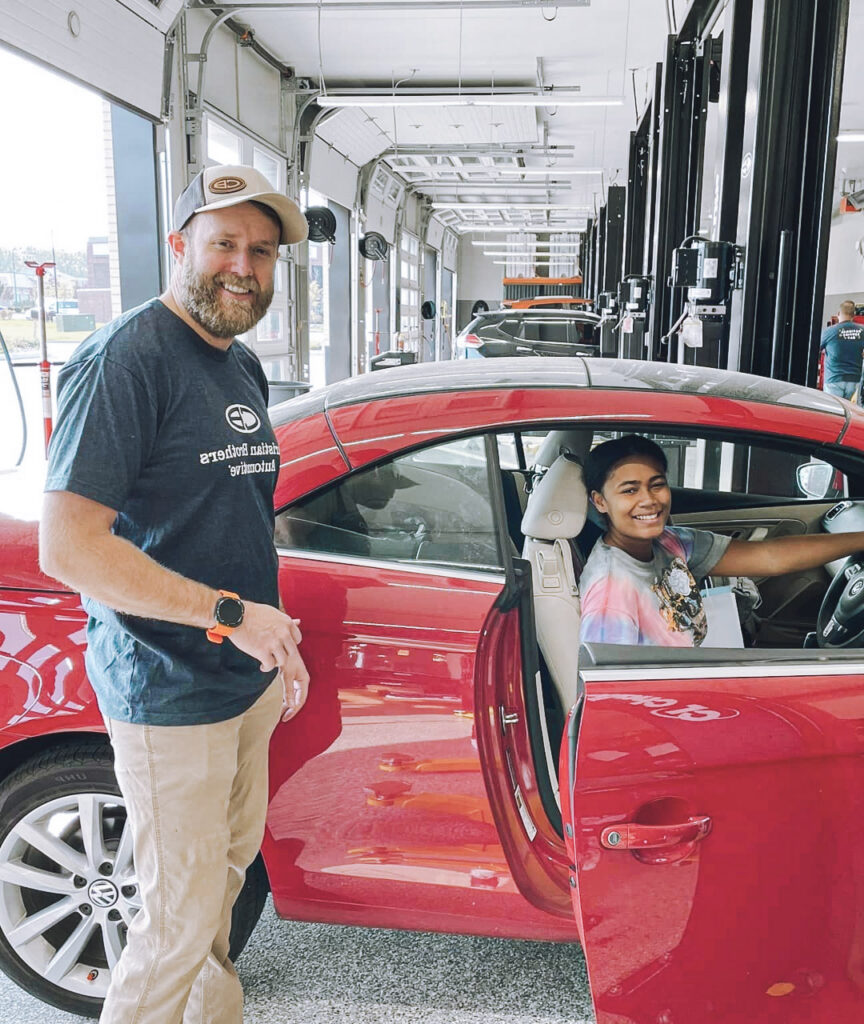
Imagine rows and rows of men volunteering their Saturday mornings to work on cars of women they’ve never met. They donate their time, their money, and their physical labor to ensure these cars are safe to drive and reliable for moms who need to get to work, school, and medical appointments. The women driving these cars are not their wives, their daughters, their sisters, or even their friends. But they are their neighbors.
This is the scene at car maintenance days in Her Communities across the country, when communities come together to fill the transportation gap for abortion-vulnerable women and their families. While licensed mechanics volunteer their time to provide oil changes and inspect cars to ensure their safety and reliability, moms are introduced to local providers and ministries that want to serve them, such as financial literacy programs, educational resources, or ministry groups. Often, a local church collaborates with local mechanics and ministries to offer moms wrap-around support and emotional connection as well as prayer.
Through boots-on-the-ground work in states across the country, our Community Engagement Division has consistently identified four major needs that often lack adequate response and available support resources: housing, childcare, mental health, and transportation. In most parts of America, a reliable car is a necessity for finding and holding down a job, getting groceries, seeing a doctor, going to church — the list goes on. Without a car, a vulnerable woman may be dependent on expensive Uber or Lyft rides to get to work, if those options are even available in her area. If she has a car but can’t make ends meet, oil changes and repairs may be at the bottom of her financial priorities, leading to more expensive emergency maintenance, further compounding her transportation issues. Addressing the transportation gap through car donations, transportation funds, and community car maintenance days helps keep abortion-vulnerable women on the road and supports them as they care for their families.
Outside of oil changes and inspections, healing and hope are unexpected outcomes of these car maintenance days. Sadly, many abortion-vulnerable women have only had negative experiences with the men in their lives. An absent father, an abusive boyfriend, a traumatic childhood: a history of broken relationships has led to a cycle of disappointment and deep hurt. When good men step up to freely give of their time to serve and support abortion-vulnerable women, it’s a step towards restoring their hope and empowering them to remember and see their inherent dignity and worth upheld and respected. At a car maintenance day, a stranger who is changing the filter in her car is sometimes the first connection restored in a chain of broken male relationships.
Georgia Community Development Coordinator Eva Dalke shared more about how the witness of the male mechanics and volunteers working on moms’ cars at the Barrow County car maintenance day in Georgia struck her:
“A lot of the gaps in the pro-life safety net that we talk about are filled by other women. But transportation is one that is often able to be uniquely filled by men in the community. How neat is it to see this crew of ten mechanics dedicating their time on a Saturday morning when they could be sleeping in to instead serve these moms in such a beautiful way.”
View this post on Instagram
For many of us, we can name the positive impact male relationships have had on our lives: a father who taught us strength, a brother who gave us guidance, a husband who supports us throughout the journey of our family. When those positive relationships aren’t there, the wound left behind is great. Her PLAN’s Her Story initiative helps promote women’s stories of their courageous choice for life or the heartbreak and hope of their abortion healing journey to help women considering abortion realize they are not alone. One of our storytellers bravely shared her story of almost being aborted as a baby, then considering abortion herself as a teen mom, suffering miscarriages, and enduring postpartum depression without shedding a tear. But when speaking about the way she felt she had disappointed her father as a child, she broke down. The wounds left behind in male relationships — father, brother, uncle, boyfriend — are carried for years after the initial pain is dealt.
It may seem like just a routine oil change that a dad or grandfather has done dozens of times for their wives, daughters, or the next customer that comes into their shop. But when that same kindness is extended to a mom who has only known hurt from men, it is the first stitch and step towards healing in a very deep wound. Everyone has a place in the pro-life safety net and through community car maintenance days, we have witnessed one of the unique and critical roles men fill. It is never just a simple oil change.
This Father’s Day, Her PLAN is grateful for all fathers for how they protect and provide for their families. And we are especially thankful for the men who have stepped up to strengthen the pro-life safety net and support abortion-vulnerable moms in their communities, upholding their dignity and restoring hope one community car maintenance day or act of service at a time.
